René Gabriel Navarro-Labastida
Ocean Modeling and Climate Variability, Physical Oceanography, Ocean Dynamics
About René
He is a Post-Doctoral Researcher at the Swedish Meteorological and Hydrological Institute (SMHI) Global Modeling at Rossby Centre in Norrköping Sweden.
His main research interest is on the North Atlantic Ocean Circulation, focusing on the Gulf Stream and Atlantic Meridional Overturning Circulation interaction.
He is originally from Ensenada Baja California México, where he graduated from the Faculty of Marine Science FCM at the Autonomous University of Baja California with a BSc degree in Oceanography.
He obtained PhD in Earth Sciences from the University of Trieste Joint PhD Programme, Earth Science and Fluid Mechanics ESFM in Trieste, Italy.
He also held a Master of Science in Physical Oceanography from the Ensenada Center for Scientific Research and Higher Education CICESE.
He had worked as a scientific assistant for The Gulf of México Research Consortium CIGoM and the Mexican Center for Innovation in Ocean Energy CEMIE.
Here the full CV, researchgate profile.
Articles
- Navarro, R., & Farneti, R. 2023. The Role of Shallow and Deep Circulations in the Tropical Pacific Ocean Heat Budget. Front. Mar. Sci., Sec. Physical Oceanography, https://doi.org/10.3389/fmars.2023.1208052
- Todd et al., 2020. Ocean-only FAFMIP: Understanding Regional Patterns of Ocean Heat Content and Dynamic Sea Level Change. Journal of Advances in Modeling Earth Systems, doi:org/10.1002/essoar.10501557.1
- Navarro, R., López, M., & Candela, J. 2016. Seasonal Cycle of Near-bottom Transport and Currents in the Northern Gulf of California. Journal of Geophysical Research: Oceans, 121. doi: 10.1002/2016JC012063
Invited talks
- La gran circulación del océano (click here). Radar Oceanográfico - UABC Radio. Ensenada, México. Marzo 2024.
- Seminario de posgrado en IIO-UABC y DOF-CICESE. (click here). Ensenada, México. Marzo 2024.
- The role of shallow and deep circulations in the Tropical Pacific Ocean heat budget. Bad Honnef Physics School, Physics of the Ocean. Bad Honnef, Germany. July, 2023 (poster).
- Ocean’s Response to Surface Buoyancy and Momentum Flux Perturbations. Centro euro-Mediterraneo sui Cambiamenti Climatici (CMCC). Bologna, Italy. March 12, 2023.
- Shallow and Interior Ocean Components of the Tropical Pacific Heat Budget. Fluids & Flows group seminars. Eindhoven University of Technology (TU/e). Eindhoven, Netherlands. March 2022.
- La Metáfora del Gran Cinturón de Circulación Oceánica: Ventilación del Océano Global y la Infravalorada Contribución del Pacífico (click here). XIV Jornada Académica de Oceanología. Puerto Ángel, México. Mayo 2022.
Contact
René Gabriel Navarro Labastida
The Swedish Meteorological and Hydrological Institute (SMHI)
The Rossby Centre
Folkborgsvägen 17, 603 80 Norrköping, Sweden
Phone: +46767201924
Email: renegabriel.navarrolabastida@smhi.se
Gallery
Taken from Navarro, R., & Farneti, R. 2023
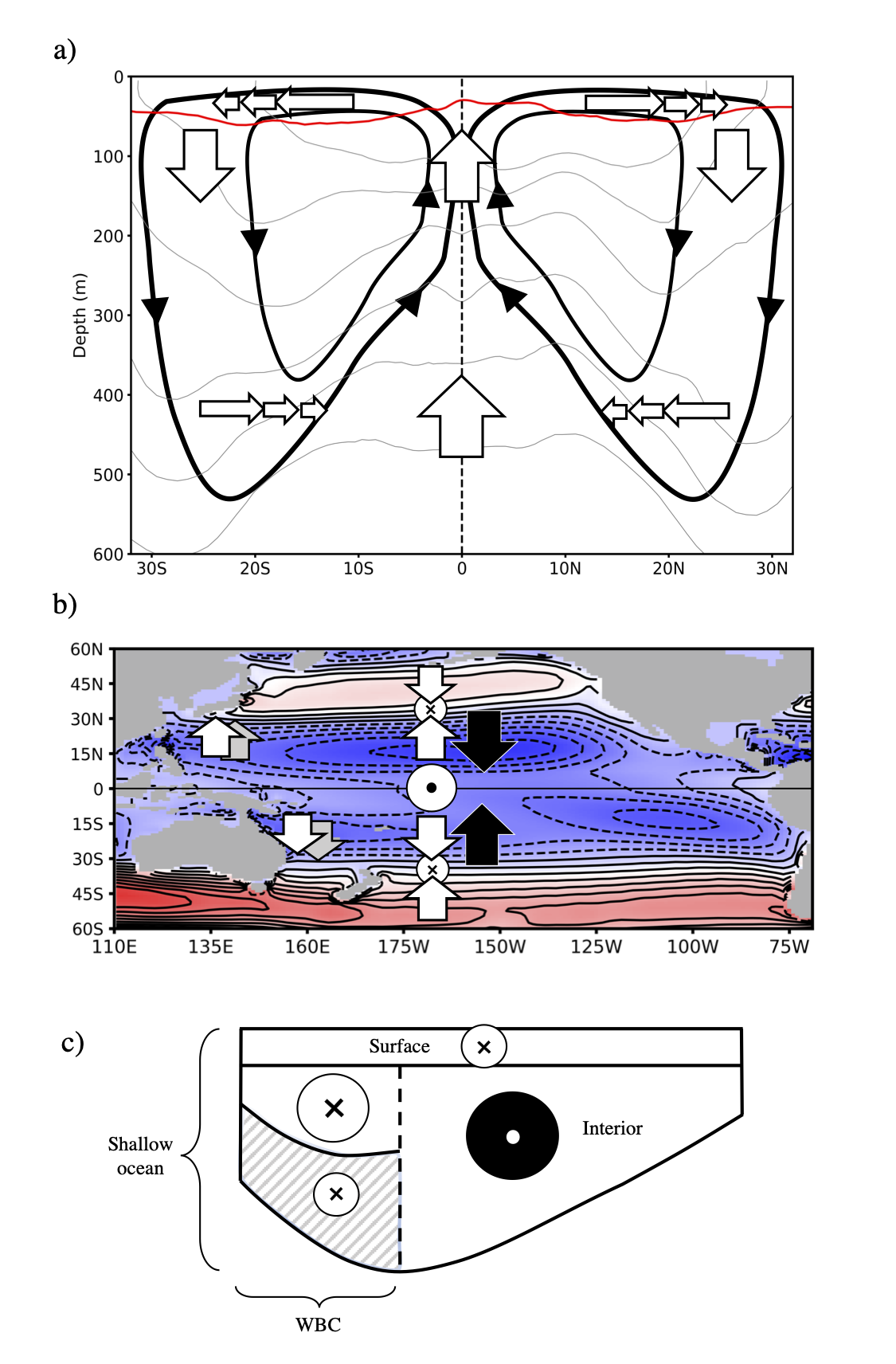 Schematic representations of the Pacific Ocean Shallow Wind-driven Meridional Overturning Circulation. (a) The time-mean and zonally-integrated Meridional Overturning Circulation. The time-mean isopycnal field (gray contours) and mean mixed layer depth (red line) are also shown. Both upper poleward and lower equatorward branches are represented by horizontal white arrows. Equatorial upwelling and subtropical downwelling flow required to close overturning circulation are also shown (upward and downward white arrows). (b) Bird’s eye view of the time-mean meridional circulation and different branches of the meridional overturn. The warm upper poleward Ekman transport (white arrows), the cold lower equatorward geostrophic interior transport (black arrows), and the subsurface Western Boundary Current contribution to the upper poleward transport (gray arrows) on the western side of the basin are shown. The equatorial upwelling and the subtropical downwelling are represented by the white upward arrow and by the white downward arrows, respectively. Contours represent the time-mean zonal wind stress. (c) Schematics of the zonal section of the Shallow Overturning Circulation inside the Subtropical Gyre, for the Northern Hemisphere across latitude 24N. The same applies to the Southern Hemisphere but inverting the signs. The Schematic is divided into surface poleward transport, the Western Boundary Current transport (WBC), and the interior equatorward transport. Balance inside the overturning cell excludes transport within deeper levels of the WBC (shaded area), which flows outside the gyre towards the Subpolar region.
Miscellaneous
- Some notes about writing style in science (Data Analysis and Statistics 2017)
- Some codes for data analysis and processing I wrote during my Ph.D. Thesis
- Many MATLAB functions made by me (Disclaimer: I stopped using Matlab a long time ago. Codes could be rather deprecated under the new coding paradigm of Matlab).
- Science Communication: Ocean in a Tank